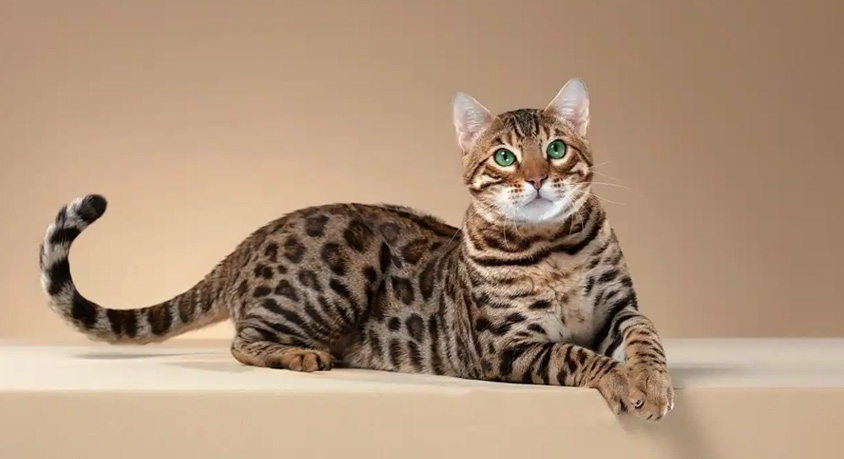
My friend Luna fell for a Bengal cat’s spotted coat hard—scroll through her old Instagram, and you’ll find screenshots of her gushing over “tiny leopards you can keep inside.” She dropped a pretty penny on Jasper, a silver-spotted Bengal with eyes like emeralds, and spent weeks prepping her apartment with a fancy bed and sleek food bowls. Three days after bringing him home, she texted me a photo of her living room: couch cushions torn open, plants knocked over, and Jasper perched on the kitchen counter, paws dripping wet from her fish tank. “I thought I bought a fancy house ornament,” she wrote. “Turns out, I signed up for a 24/7 wild animal bootcamp.” That’s the unfiltered truth about Bengals: they’re not just pretty spotted cats—they’re half wild, all energy, and owning one means paying a “wild price” in time, space, and sanity. If you’re not ready to keep up, this “domestic leopard” will turn your home into a war zone.
Let’s start with their DNA: Bengals are a cross between Asian leopard cats (a small wild feline) and domestic cats, bred to have that exotic spotted look without the full wildness. But here’s the catch—75% of their behavior comes from their wild roots, per feline behavior studies. Jasper’s endless zoomies? That’s the leopard cat’s need to cover miles hunting in the wild. His obsession with water? Asian leopard cats live near streams and hunt fish, so Jasper thinks every body of water (tubs, sinks, even the fish tank) is his personal playground. Luna now keeps her bathroom door locked 24/7 and invested in an interactive water fountain—“He’ll splash in it for an hour, then drink half the water and spill the rest,” she laughs, though there’s no humor in her voice when she talks about the $300 fish tank filter he destroyed.
Energy-wise, Bengals are in a league of their own. A 2024 survey by the International Cat Association found that Bengals require 2-3 hours of intense, structured play daily—double the amount of a regular house cat. This isn’t just “throw a toy mouse” play; they need puzzle feeders that make them “hunt” for food, multi-level cat trees to climb like they’re scaling trees in the wild, and even leash walks outside (yes, leash-trained cats) to burn off steam. Luna tried skipping a day when she was sick, and Jasper responded by tearing up her favorite rug and knocking over her TV. “He’s not being naughty—he’s screaming for stimulation,” her vet told her. “A bored Bengal is a destructive Bengal.”
Their predatory instinct is another non-negotiable reality. Bengals see small objects (and sometimes small pets) as prey—Jasper chases her hamster’s cage relentlessly, and she’s had to rehome her pet bird because he kept trying to pounce on it. Even socks and hair ties become “prey” that he hides under the couch or carries around like trophies. “He’ll bring me ‘gifts’ of chewed-up rubber bands at 3 a.m.,” Luna says. “I know it’s his wild instinct, but it’s hard to appreciate when I’m stepping on rubber band scraps at 7 a.m.”
The worst part? Luna’s story isn’t unique. The same ICA survey found that 60% of Bengal owners surrender their cats within the first year, citing “unmanageable energy” and “destructive behavior.” Bengals aren’t bad cats—they’re just cats that haven’t fully shed their wild side. They need owners with large homes (studio apartments are a hard no), flexible schedules to provide playtime, and the patience to handle their quirks. Luna eventually turned her spare bedroom into a “Bengal playground” with a 6-foot cat tree, puzzle feeders, and a kiddie pool for water play. Now Jasper’s calmer, but she admits it’s a full-time job: “I don’t have a pet—I have a roommate with fur and a hunting problem.”
If you’re drawn to Bengals for their exotic looks, pause before you buy. That “domestic leopard” comes with a bill: time, money, space, and a whole lot of chaos. They’re perfect for active, cat-obsessed owners who want a “wild” companion—but terrible for anyone who wants a lap cat that sleeps 18 hours a day. Luna loves Jasper now, but she wishes someone had told her the truth before she fell for his spots: “He’s amazing, but he’s not for everyone. The wild price tag isn’t just money—it’s your sanity.” Don’t make the same mistake: admire Bengals from afar, or be ready to pay up.