Throughout the training process, trainers must master and apply the principles of luring, coercion, prohibition, and reward to ensure dogs rapidly form conditioned reflexes for specific commands. This approach continuously strengthens and enhances the dog's abilities, guaranteeing smooth execution of actions under various complex conditions. This mastery is the cornerstone of effective training.
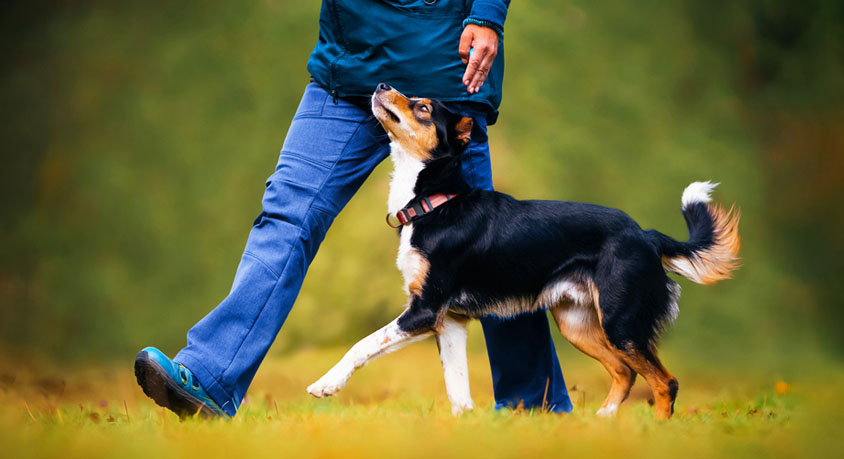
Induction refers to training methods that utilize all favorable opportunities and diverse stimuli—such as food, objects, or the trainer's own actions—to prompt the dog to perform specific movements, thereby accelerating the establishment of conditioned reflexes. Examples include: using food to entice the dog to sit, lie down, come, or stay; employing natural environments to guide the dog through various obstacles; and triggering barking or pouncing through observation and imitation. For training young dogs, whose physical constitution and nervous system development are still immature, making them less tolerant of coercion, this method is particularly suitable. Additionally, certain scent-based tasks often yield significant results when using luring techniques. Its advantages include: the dog performs actions with greater excitement and naturalness, and it is especially effective for scent analysis and identification.
The disadvantage is that it cannot guarantee the dog will consistently perform the required action accurately under all circumstances. When employing guidance, note the following:
(1) Tailor the timing to the dog's characteristics. Avoid constant reliance to prevent it from replacing verbal commands or hand signals.
(2) Skillfully utilize various terrains and objects.
(3) Combine guidance with mechanical stimuli and rewards. Immediately after guiding the dog to perform an action, use mechanical stimuli to reinforce the correct behavior while simultaneously applying rewards.
(4) Integrate routine guidance with formal training to gradually establish standardized actions.
Compulsion refers to a training method that uses only mechanical stimuli and threatening tones to force dogs to perform actions accurately and smoothly. When employing compulsion, note the following:
(1) Threatening tone commands must be accompanied by strong mechanical stimuli; otherwise, dogs will not form conditioned responses to the threatening tone.
(2) Compulsion must be combined with rewards. Compulsion forces the dog to perform the action, while rewards reinforce and consolidate the behavior, mitigating any adverse effects caused by compulsion.
(3) Compulsion techniques must be tailored to the dog's individual characteristics. For dogs that tolerate strong stimuli, the intensity can be appropriately higher. However, for dogs with sensitive skin, heightened sensitivity, or timid dispositions, the intensity should be appropriately lower.
(4) Coercive methods must be subject-specific. Particular caution is required during training exercises like identification, tracking, and search to avoid adverse outcomes.
(5) Avoid excessive coercion. Overuse can cause dogs to fear trainers or avoid training. Coercion should only be applied when the dog is comprehending the action but delaying execution. In disciplines like barking, scent source identification, tracking, and discrimination, excessive coercion will only produce counterproductive results.
Prohibition is a method employed to halt undesirable behavior in dogs. The command “No” is issued in a threatening tone, accompanied by a strong mechanical stimulus to cease the undesirable action. When applying prohibition, note the following:
(1) The " “No” must be paired with a strong mechanical stimulus, delivered with a stern and serious demeanor.
(2) Interrupt the dog's undesirable action promptly, seizing the moment—ideally as the behavior begins.
(3) When the dog stops the undesirable action, provide appropriate rewards.
(4) Stimulation intensity must be tailored to the dog's individual characteristics, with particular attention during training of puppies.
(5) Avoid overuse.
Rewards are employed to consolidate and reinforce correct actions, encourage the dog to perform desired behaviors, and regulate its nervous system. Reward methods include: the “Good” command, petting, and allowing the dog to run freely. When to Use Rewards:
(1) During the initial phase of each training exercise, ample rewards must be given for every precise action to rapidly establish conditioned responses. Food and petting should be the primary rewards.
(2) Once the dog forms a conditioned response to the “Good” command, food rewards can gradually decrease. The “Good” command alone or combined with petting can then be used for reinforcement. However, to prevent fading of the “Good” cue, intermittent food rewards remain necessary.
(3) After extended training sessions or demanding tasks, allowing brief free play serves as an effective reward by relieving the dog's nervous tension. This should be incorporated into training routines.
Additionally, trainers can leverage the dog's high excitement during retrieving tasks to satisfy its retrieving instinct, which also serves as an effective reward method.
(1) Maintain a friendly and approachable demeanor when rewarding. Reinforce the “Good” cue consistently with food and petting.
(2) Rewards must be timely and well-timed. Promptly rewarding correct actions not only accelerates the formation of conditioned reflexes but also cultivates the habit of swift execution.
(3) Rewards must be purposeful. Avoid incessantly praising incorrect actions, as this fosters undesirable associations. For example: the dog may develop bad habits like randomly biting objects, chewing on the owner's hands, feet, or clothing, or climbing onto the owner.
(4) Employ different reward methods based on the specific training subject and its current stage.
(5) Correctly apply rewards according to the requirements of each distinct training phase.